Advice
Why your lawn is thinning under the trees
The sunny half looks great and the shady half keeps giving up. It's not bad luck, it's light, and there's a way to work with it.
30 September 2026 · 6 min read · Thirsty Lawn Solutions
Most Perth backyards have one. The patch under the peppermint tree, the strip along the side fence, the corner the patio roof keeps in shadow half the day. The rest of the lawn is thick and green, and that bit just keeps thinning out no matter what you throw at it.
It's not a fertiliser problem and it's usually not a watering problem either. It's light. Grass runs on sunlight, and when it doesn't get enough, everything else you do has less to work with.
The good news is that a shaded lawn can still look good. It just needs to be looked after differently to the sunny bit. Here's how.
Why grass struggles in shade
Grass makes its food from sunlight through the leaf. Cut down the light and you cut down the food, so the plant has less energy for everything else: growing new leaf, spreading runners, pushing roots down, recovering from wear.
A shaded lawn tends to show it in the same ways. The leaf goes long and stretched as it reaches for light. The runners spread out and the cover gets sparse. Bare soil starts showing between the blades, and anything that lands in those gaps gets a head start.
Trees make it harder again, because shade is only half of what a tree does to a lawn. Tree roots sit in the same top layer of soil as the grass roots and compete for the same water and nutrients. On free-draining Perth sand, where water and feed are already hard to hold, the tree usually wins.
Pick the right grass for the light you've got
Before anything else, it's worth knowing what's actually growing there. Some grasses handle shade far better than others.
Buffalo is the best of the common Perth lawns in shade by a clear margin, which is why it's the usual answer for yards with big trees or tall fences. It still has limits, though. Turf growers generally put the floor at a few hours of direct sun a day, and past heavy shade even buffalo can't hold on.
Couch and kikuyu are sun lovers. In shade they go thin and leggy fast, and there's not much you can do in the way of care that makes up for it.
If your shady patch is couch or kikuyu and it keeps failing, the problem might be the grass rather than the care. Our guide to couch, buffalo and kikuyu goes through how to tell them apart and which one suits which part of the yard.
Mow the shady bit higher
This is the single biggest change you can make, and it costs nothing.
Leaf is where the plant catches light. In the sun, grass has light to spare and can cope with a shorter cut. In shade, every bit of leaf counts, so taking it off hurts twice as much. Leave it longer and the plant has more surface to work with.
For buffalo in shade, sit it at the top of its normal range or above. Around 50mm is a good starting point, and in heavier shade it can go higher again. Whatever the grass, stick to the one third rule and never take off more than a third of the leaf in one cut. We've covered heights for each grass type in how short to cut a Perth lawn.
If you can, set the mower higher for the shaded section than for the rest. It's a small bit of effort for a big difference.
Water the shade less than the sun
It sounds backwards, but shaded lawns usually need less water than sunny ones, not more. Less sun means less evaporation, so the soil stays damp for longer.
Watering shade on the same schedule as full sun tends to leave it wet for too long. That brings its own problems: soft, weak growth, moss, and conditions that fungal problems love. If your retic runs one program over the whole yard, check the shaded section a day or two after watering. If it's still damp, it's getting more than it needs.
The exception is right under a tree canopy, where the tree's roots can drink the soil dry and the canopy itself stops some of the water ever reaching the ground. Push a finger into the soil there and let that tell you, rather than guessing.
Whatever the watering, it has to fit inside your two rostered days. Our Perth watering days guide has the details.
Don't try to feed your way out of it
When a patch looks tired, the instinct is to give it more fertiliser. In shade that rarely works, because the plant's limit is light, not food. Pile on feed and you often just get soft, floppy leaf that wears out quickly.
A shaded lawn still needs feeding, just steady and moderate rather than heavy. Little and often, on a proper seasonal plan, is the way to do it. That's what our lawn aftercare programs are built around, with the feed matched to how each part of the lawn is actually growing.
Give it more light where you can
The most effective shade fix is less shade.
Lifting the canopy on overhanging shrubs and small trees, thinning out dense growth and cutting back hedges that lean over the lawn can make a real difference to how much light reaches the grass. Even an extra hour or two of direct sun in the morning can be the difference between a lawn that holds on and one that doesn't. Our hedging and pruning service covers shrubs and hedges. Large trees are a job for a qualified arborist.
Keep the foot traffic off
A shaded lawn recovers slowly, because it's running on less energy. So wear that a sunny lawn shrugs off in a week can leave a shaded patch bare for months.
If the shady strip is also the path to the clothesline, the shed or the side gate, the grass is fighting two battles at once. A few stepping stones or a paver path through the busiest line lets the grass either side get on with growing.
When to stop fighting it
Some spots will never grow a good lawn. A narrow side yard with a two storey wall on one side and a fence on the other. The ground right under a dense, low tree. Corners that don't see direct sun for most of the day.
You can keep patching those areas every spring, or you can give them a job they'll actually do well. A garden bed with a good layer of mulch, a clean pebble or gravel finish, or a paver path with gravel either side all look deliberate, need almost no water and never need mowing.
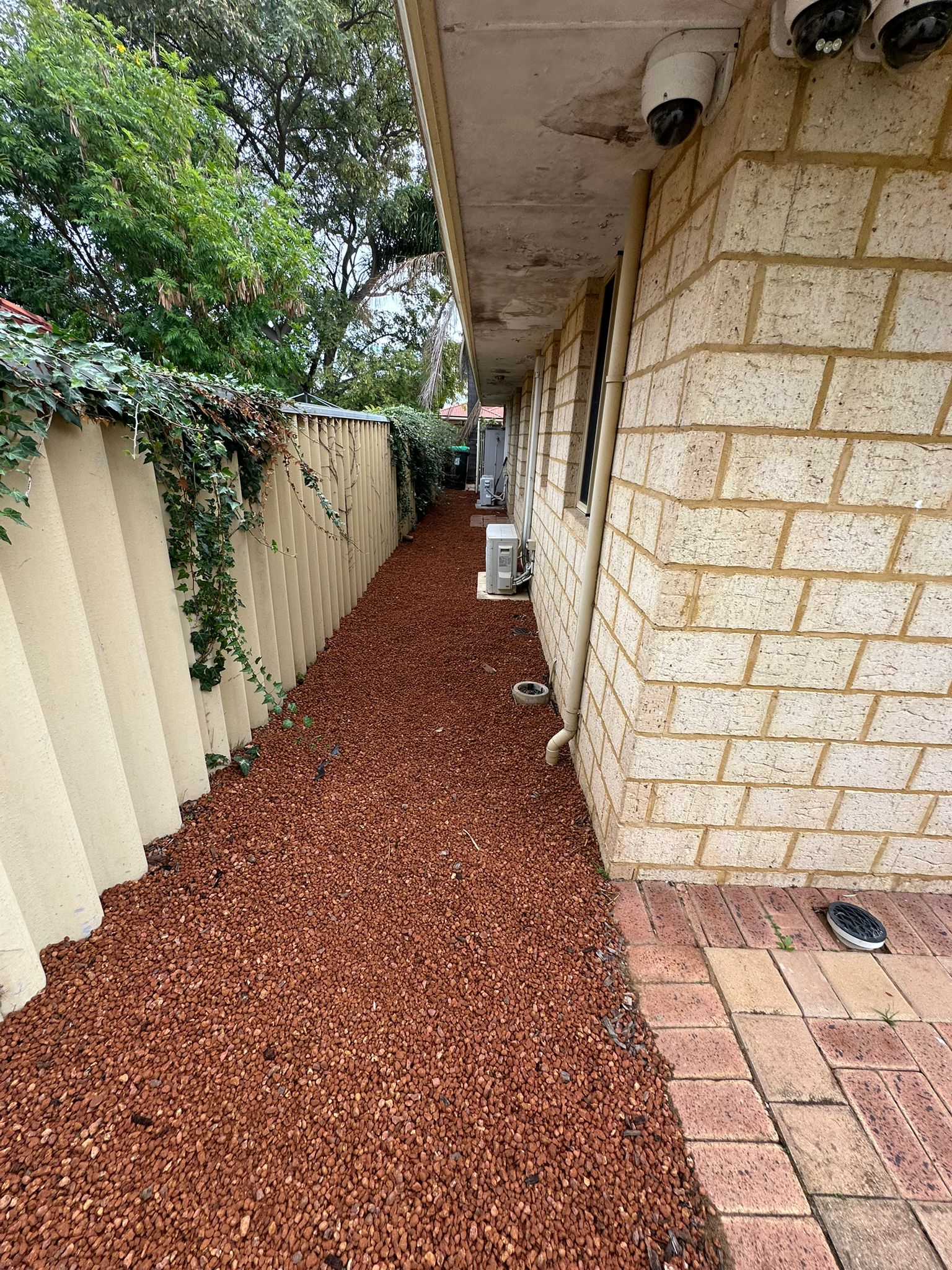
We've compared the options in mulch vs pebbles vs gravel if you're weighing it up.
The short version
Work out how much sun the patch really gets. If it's couch or kikuyu in heavy shade, it may be the wrong grass for the spot. Mow the shade higher, water it less, feed it steadily instead of heavily, let more light in where you can and keep traffic off it. And where a lawn just won't grow, give that ground a different job.
Every yard's shade is different, which is why we look at the whole lawn before we suggest anything. Tell us about yours through the quote form and we'll reply within one business day with a plan tailored to your turf, not a template.
Want your lawn handled properly?
Get a free, no-obligation quote and we’ll get back to you, usually within one business day.